
Why Does Everything Feel So Loud Lately?
Anxiety, Overstimulation, and the Modern Nervous System
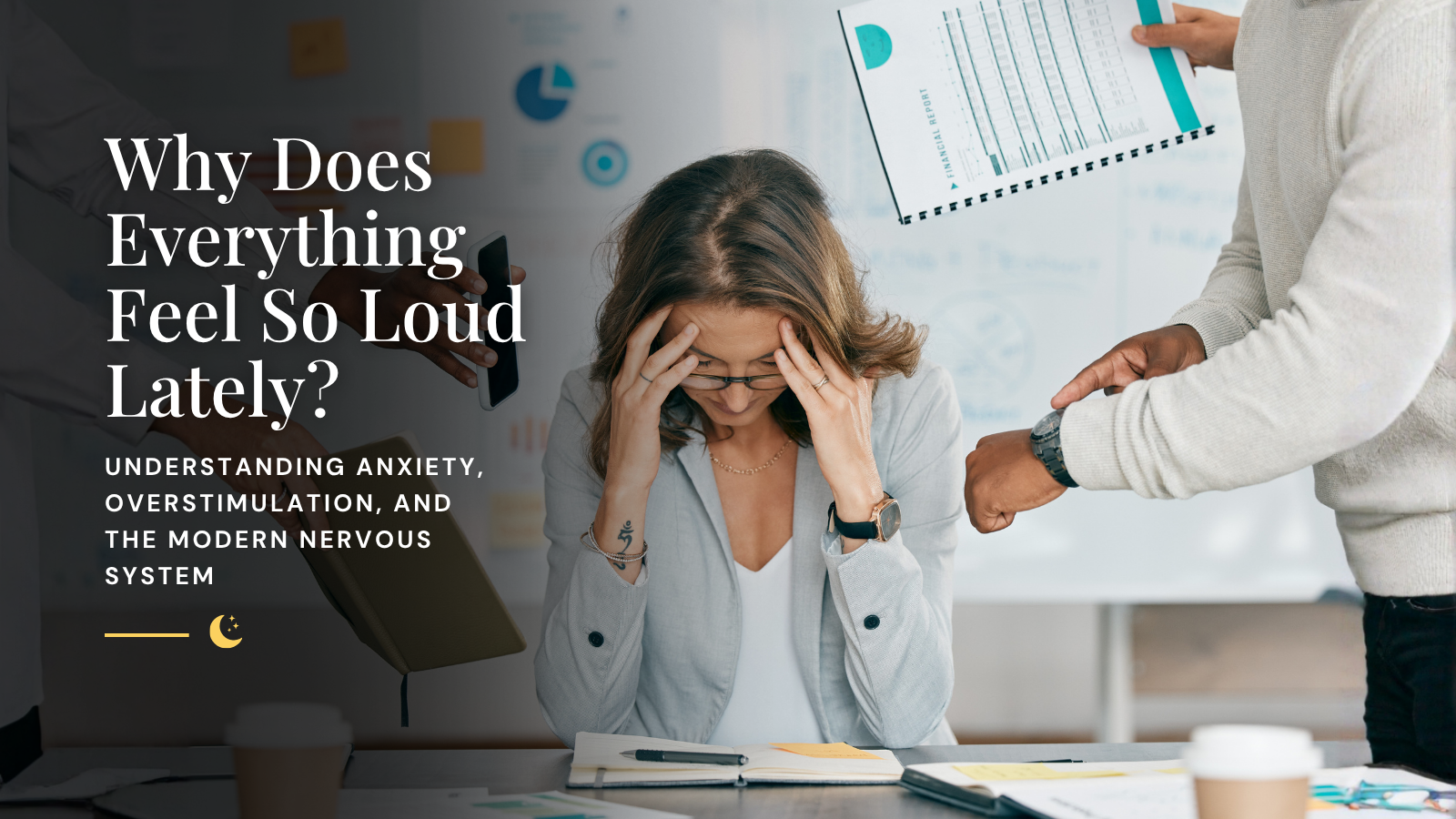
Sometimes women come into therapy and say some version of this:
"Nothing terrible is happening, but I feel overwhelmed all the time."
Or: "I feel like I can't think."
Or simply: "Everything feels loud."
Not loud in volume.
Loud in demands. Loud in responsibilities. Loud in decisions, notifications, expectations.
When I hear it, I don't hear a sign that something is wrong with you. I hear a nervous system that has been carrying more than it was built to hold.
The World Has Become Incredibly Stimulating

Our brains evolved to notice change, novelty, and potential threat. That was useful when the threats were occasional.
Now we live inside a nearly constant stream of information competing for attention.
Emails. Texts. Group chats. News alerts. School notifications. Social media. Calendar reminders. Work messages. Marketing. Family logistics.
The brain doesn't reliably distinguish between a genuine emergency and another notification asking for your attention. It simply learns one rule: stay alert.
And eventually, staying alert stops feeling like a response to anything. It just feels like your baseline.
When Your Nervous System Never Gets to Power Down
A lot of the women I work with live in a near-constant state of low-level activation.
Not panic. Not crisis. Just on.
Planning tomorrow while finishing today. Thinking about work while making dinner. Remembering appointments while answering emails. Listening to your child while mentally writing the grocery list.
From the outside, that looks like functioning. Internally, it can feel like static.

Signs Your Nervous System May Be Overloaded
You might notice:
Feeling irritated by small noises
Difficulty concentrating
Feeling touched out or emotionally maxed out
Snapping more easily than usual
Trouble relaxing even when you finally have time
Feeling exhausted but unable to fully rest
Becoming overwhelmed by simple decisions
Almost every woman I've discussed this list with has read it as evidence of a personal failing. Laziness. Weakness. Not coping as well as everyone else.
It's usually simpler than that. Your nervous system is asking for less input.
Anxiety Loves Noise
An anxious brain scans for problems to solve and threats to anticipate. The more stimulation it takes in, the more material it has to work with.
More headlines. More comparisons. More decisions. More uncertainty. More things that could go wrong.
Eventually the brain starts treating everything as equally urgent.
And when everything feels urgent, nothing feels manageable.

So What Helps?
Not becoming more productive. Not finding the perfect routine. Not optimizing your way out of overwhelm — that's more input, which is the opposite of what's needed.
It usually starts with creating moments of less. Less input, less urgency, less pressure to respond immediately.
Regulation often looks unremarkable:
Sitting outside without your phone
Driving without a podcast
Folding laundry in silence
Taking a walk without tracking it
Letting your brain experience quiet again
None of that will feel like enough at first. It isn't supposed to be impressive. It's supposed to be quiet.
When It's More Than Overstimulation
Most overstimulation eases when the input eases. If yours doesn't, it's worth looking a little further.
Difficulty filtering noise and feeling flooded by ordinary input are common experiences for women with ADHD and many don't discover that until adulthood.
Sensitivity to sound and light, along with new difficulty concentrating, can also show up during perimenopause and in the postpartum period.
And persistent difficulty concentrating or relaxing can have physical contributors, including thyroid changes, sleep disorders, and anemia. If this has been going on for a while or is getting worse, it's worth a conversation with your healthcare provider alongside a therapist.
You Weren't Designed to Be Available to Everyone All the Time
Modern life asks a great deal of women more than most of us stop to account for.
If everything feels loud lately, your nervous system probably isn't failing you.
It may just be asking for room to breathe.
Common Questions
Why do small noises bother me so much lately?
When your nervous system is already near capacity, ordinary input has nowhere to go. Sound sensitivity is often one of the first signs of overload rather than a problem with the noise itself.
Is overstimulation the same as anxiety?
They're related but not identical. Overstimulation is about volume of input; anxiety is about threat and anticipation. Sustained overstimulation can drive anxiety, and anxiety makes you more sensitive to input, which is why they so often show up together.
Why can't I relax even when I finally have time?
A nervous system that has been activated for a long stretch doesn't switch off just because your schedule opens up. Settling takes longer than the free hour usually allows, which is why one quiet evening rarely feels like enough.
Does this mean I need to quit social media?
Not necessarily. What tends to help more than deleting everything is reducing how much input arrives unasked, notifications, alerts, autoplay, so that you choose when to engage rather than being interrupted into it.
Therapy Can Help Quiet the Noise
If you feel overwhelmed, overstimulated, emotionally exhausted, or constantly "on," therapy can help you understand what's keeping your system activated and what it would take to let it settle.
At Crescent Moon Therapy, I work with women across Washington State navigating anxiety, perfectionism, burnout, intrusive thoughts, and emotional overwhelm. Sessions are fully online, so you can meet from wherever you are.
Together we can work toward a nervous system that feels safer, quieter, and better supported.