

I Rested All Weekend. Why Am I Still Exhausted?
Anxiety, Mental Load, and the Kind of Tired Sleep Doesn't Fix
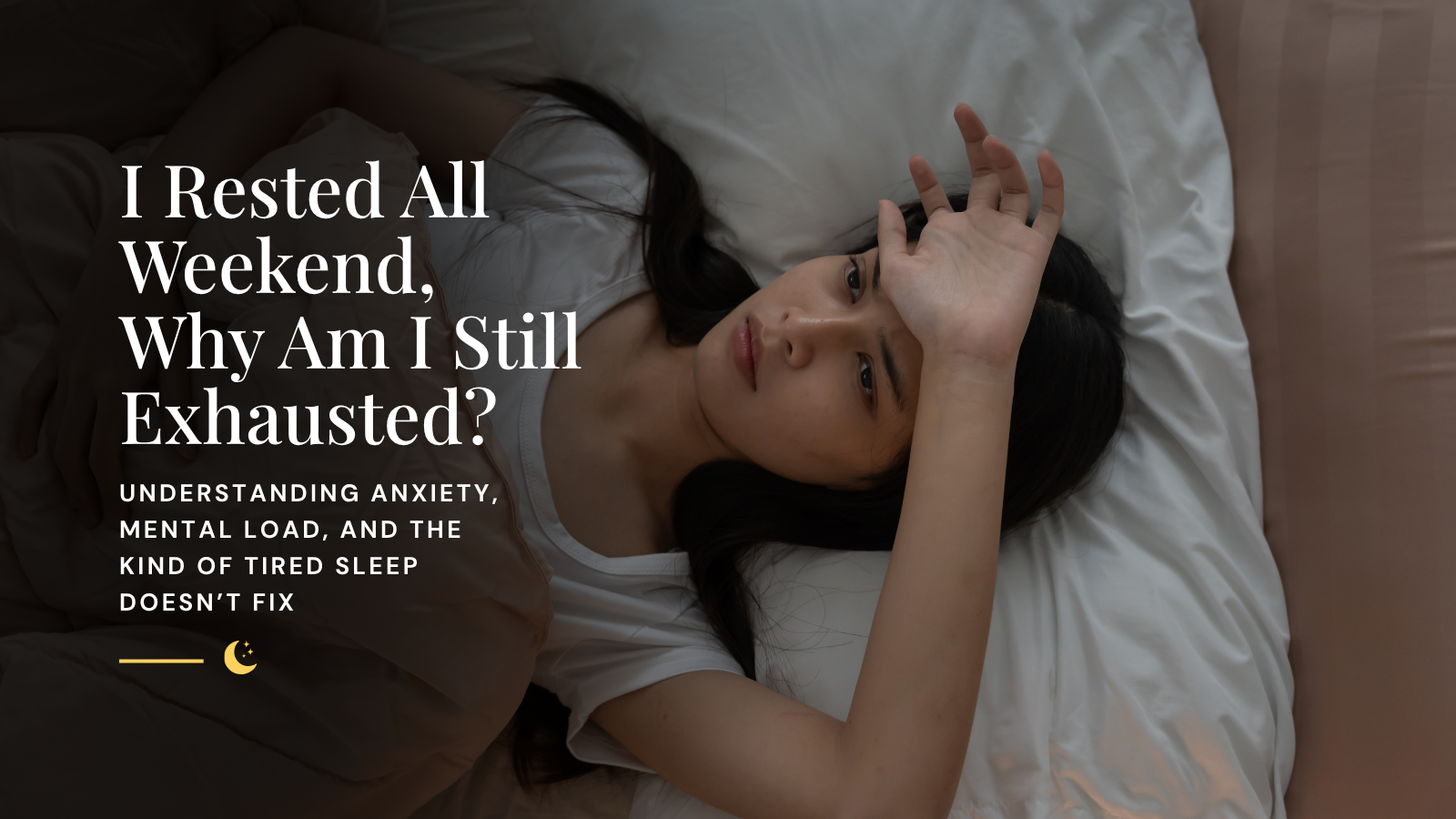
One of the most common things I hear in my practice is some version of this:
"I don't understand why I'm so tired."
She slept. She stayed home. She canceled plans. She rested all weekend.
And Monday arrives, and she still feels depleted.
If you've ever thought "I shouldn't feel this exhausted," I want you to know how often I hear it and that it usually has an explanation.

Not All Exhaustion Is Physical
We tend to think of rest as the opposite of activity. Stop moving, and you recover.
Mental and emotional exhaustion don't follow that rule.
You can rest your body while your mind never fully stops working. In my work with women across Washington, this is the pattern I see most often, not a lack of sleep, but a lack of any moment when the thinking stops.
Many women carry a workload that never appears on a calendar.
Remembering appointments. Managing schedules. Planning meals. Tracking birthdays. Monitoring everyone's mood. Anticipating needs before they're spoken. Keeping the whole thing moving.
None of that pauses because you sat down.
Anxiety Is Expensive
Anxiety uses energy. A lot of it.
Not because you are doing anything wrong. Because a brain that is trying to prevent every possible problem is a brain that never gets to rest.
Running scenarios. Preparing for what might go wrong. Replaying a conversation to check how it landed. Scanning for the thing you forgot.
That kind of vigilance is genuinely effortful. It just doesn't look like effort from the outside, and it rarely gets counted as work, including by the person doing it.

High-Functioning Doesn't Mean Unaffected
Most of the women I work with are still showing up.
They go to work. They care for their families. They meet deadlines and remember the permission slips and check in on everyone else.
From the outside, they look fine. Often they look successful.
Internally, many describe it as sprinting through every single day.
That gap between how it looks and how it feels, is one of the loneliest parts of anxiety. It's also why so many women wait years before reaching out. If you are managing, it can feel like you haven't earned the right to struggle.
You may find yourself asking, "Why can't I handle what everyone else seems to handle?"
In my experience, the answer is rarely that you are weak. More often, you have been carrying more than anyone around you can see.
Rest and Recovery Are Not the Same Thing
Rest matters. But rest and recovery are different things, and confusing them is why a quiet weekend can leave you no better than you started.
Rest is the absence of activity. Recovery is what allows a stressed system to settle.
For many women, recovery involves:
Reducing the mental load, not just pausing it
Setting boundaries that hold up when someone pushes back
Letting yourself stop performing, including at home
Building moments of real safety and calm into ordinary days
Processing emotions rather than carrying them alone indefinitely

Sometimes what you need isn't a day off. Sometimes it's support.
The Guilt That Arrives With Rest
There is one more piece I hear about constantly, and it deserves its own name.
You finally sit down. And within about ninety seconds, your mind starts listing everything you should be doing instead.
The laundry. The emails. The errands. The half-finished project.
Rest turns into one more task, something to complete correctly. And when you get up and still don't feel restored, it can land as one more thing you failed at.
You did not fail at resting. Rest was never designed to solve a problem that isn't about sleep.
When Exhaustion Is Information
I often invite the women I work with to consider that exhaustion may be telling them something rather than simply happening to them.
It may be information that you have been carrying too much for too long. That your body has spent a long stretch in a heightened state. That your mind has had few real opportunities to power down.
Or that what you need is something deeper than sleep.
That reframe matters, because "why am I so tired" tends to turn into "what is wrong with me." Usually nothing is wrong with you. Something is asking for attention.
When to Talk to a Doctor
I want to be direct about this, because it's important.
Persistent fatigue can have physical and medical causes. Thyroid conditions, anemia, sleep disorders, vitamin deficiencies, and a number of other conditions can all produce exhaustion that no amount of therapy will resolve.
Anxiety and mental load are not always the explanation, and I would never want this article to talk you out of a conversation you should be having with a physician.
If your exhaustion is ongoing, worsening, or concerning to you, please talk with your healthcare provider as well. Mental health support and medical care are not alternatives to one another.
Common Questions
Why am I still tired after eight hours of sleep?
Sleep addresses physical tiredness. If what's depleting you is sustained mental effort — worry, vigilance, emotional labor — sleep alone may not touch it. Medical causes are also worth ruling out with your doctor.
Is this burnout or anxiety?
They overlap and often occur together. Burnout is generally tied to prolonged demand without adequate recovery; anxiety involves persistent worry and a heightened state of alert. Many women I see are experiencing both. You don't need to sort out which one it is before reaching out.
Why do I feel guilty when I rest?
Because rest has quietly become another performance. If your sense of worth is tied to output, stopping can feel like falling behind rather than recovering. That belief is workable, and it's one of the more common things we address in therapy.
Can therapy actually help with exhaustion?
It can help with the patterns underneath it , the mental load, the difficulty setting limits, the sense that stopping isn't allowed. When those shift, rest tends to become more restorative.
Therapy Can Help You Carry Less
If you feel emotionally exhausted, overwhelmed, or caught in a cycle of pushing through, therapy can help you understand what is keeping your mind working overtime and what it would take to let it slow down.
At Crescent Moon Therapy, I work with women across Washington State navigating anxiety, perfectionism, burnout, intrusive thoughts, mental load, and emotional overwhelm. Sessions are online, so you can meet from wherever you are in the state.
Together we can work toward boundaries that hold, fewer patterns that keep you constantly "on," and rest that actually restores something.
You spend so much time carrying everything else. You deserve support, too.