
The Emotional Cost of Social Media
How Online Pressure Quietly Impacts Anxiety, Self-Worth & Emotional Wellbeing
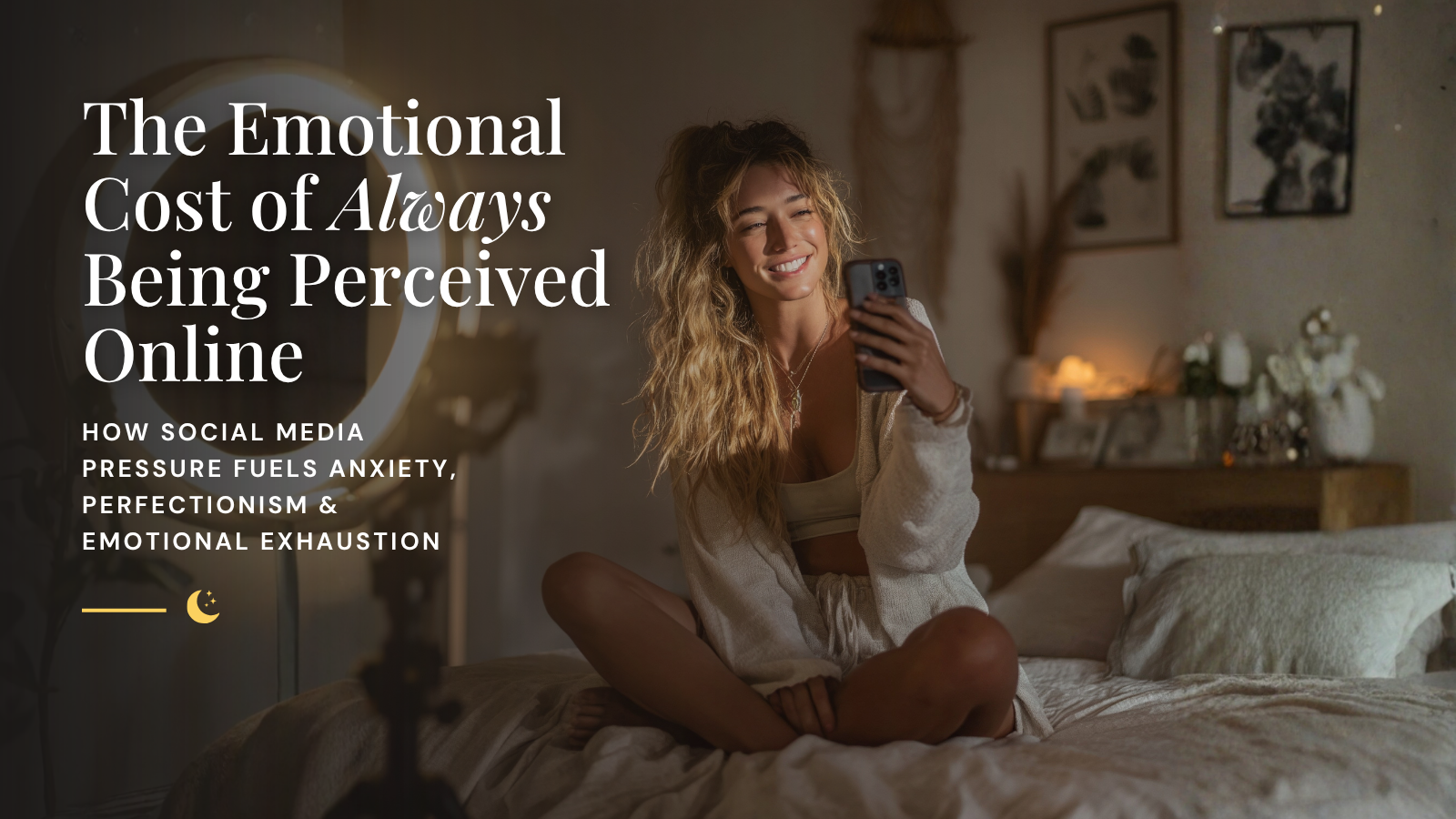
There is a quiet kind of exhaustion a lot of women are carrying right now, and it rarely gets named.
The feeling of always being visible. Always reachable. Always half-aware of how you might be coming across.
Social media has built an environment where it no longer feels possible to simply exist privately. There's an ambient pressure to seem productive, emotionally steady, successful, attractive, likable, or just okay continuously, and to an audience.
In my practice, women rarely arrive saying "social media is the problem." They arrive tired in a way they can't account for. Often this is part of it.
The Pressure to Curate Yourself

Social media asks you to think carefully about how you present yourself.
What to post. What not to post. How it might be read. Whether anyone will respond. Whether you seem successful enough, happy enough, connected enough.
You might recognize some of this: rereading a message four times before sending, rewriting a caption, feeling a jolt of anxiety after posting, checking back for responses, comparing your ordinary Tuesday to someone else's highlight, or working to appear fine on a day you aren't.
None of that is vanity. It's monitoring and monitoring is work. Done continuously, it's the kind of work that leaves you depleted without anything to point to.
Why It Affects Mental Health More Than It Seems To
Humans are built to care about belonging. That instinct isn't a flaw it kept us alive.
What's changed is scale. The number of people you feel observed by in a given day is now vastly larger than anything we evolved to manage.
For women already navigating anxiety, OCD, perfectionism, or people-pleasing, that amplification lands hard.
It can show up as chronic self-consciousness, fear of judgment, heightened social anxiety, overthinking, and a persistent difficulty settling, even when you're finally alone.

The Fear of Being Misunderstood
There's another layer that comes up constantly in session: the fear of being read wrong.
Texts, captions, response times, comments, punctuation, even how long someone takes to reply all of it starts to feel loaded. For an anxious mind, this becomes a loop of analyzing interactions and trying to manage how you're being experienced by people you may never speak to directly.
This gets especially heavy for women dealing with rejection sensitivity, people-pleasing, perfectionism, or relational OCD.

Constant Visibility Is Its Own Kind of Tired
There's very little genuine privacy left in an ordinary day.
Notifications continue. Messages arrive instantly. The expectation is that you're responsive, informed, engaged, present.
Eventually even rest starts to feel like something you might be observed doing a thing to photograph, log, or justify. Rest that has an audience isn't quite rest.
What Actually Helps
None of this means social media is inherently harmful, or that you need to delete everything. What tends to help more is noticing what being constantly perceived is costing you.
A few questions worth sitting with:
Do I feel emotionally drained after being online?
Am I thinking about how I'm being perceived even when I'm offline?
Do I feel pressure to appear okay all the time?
Can I fully relax without checking something?
And small boundaries that hold up better than dramatic ones:
Taking intentional breaks from specific apps rather than all of them
Muting or unfollowing comparison-heavy accounts, without announcement
Turning off notifications so you choose when to engage
Keeping some experiences undocumented on purpose
Spending time with people who already know what your life actually looks like
When It's More Than Social Media
Most of this eases when the input eases. If yours doesn't, there may be more going on underneath.
Persistent fear of being judged that follows you offline, into work and social settings, may be social anxiety rather than a reaction to a feed.
Repetitive checking, mental reviewing of interactions, and a need for reassurance about whether you upset someone can be features of OCD, including relational OCD, which often goes unrecognized for years.
And difficulty putting the phone down despite wanting to, particularly alongside lifelong trouble with focus and task-switching, is something many women with ADHD recognize.
If any of that sounds familiar, it's worth exploring with a professional rather than treating it as a discipline problem.
Common Questions
Is social media actually bad for mental health, or is that overstated?
The research is genuinely mixed, and it depends heavily on how you use it. Passive scrolling and comparison tend to correlate with worse outcomes; active connection with people you know tends not to. "How am I using it" is usually a more useful question than "is it bad."
Why do I feel anxious after posting something?
Posting creates a gap between putting something out and learning how it was received. Anxious minds fill that gap with prediction. The discomfort usually isn't about the post — it's about waiting without information.
Do I need to quit social media to feel better?
Usually not. Most women I work with find that reducing unrequested input — notifications, alerts, comparison-heavy accounts changes more than deleting apps, and it's far easier to sustain.
How do I know if this is anxiety or just normal modern stress?
Modern stress lifts when the pressure does. Anxiety keeps running after the input stops, and it tends to carry a sense that if you stop monitoring, something will go wrong.
You Were Never Meant to Be "On" All the Time
Modern life asks your nervous system to process an enormous amount of visibility, stimulation, and social pressure. If you feel exhausted, overstimulated, or constantly aware of how you're being perceived, that isn't a personal failing.
Therapy can help you understand the patterns underneath the anxiety, perfectionism, and self-monitoring and build ways to reconnect with yourself that don't depend on how anything lands.
At Crescent Moon Therapy, I provide online therapy for women across Washington State, including Seattle, Tacoma, and Gig Harbor. I specialize in anxiety, OCD, perfectionism, burnout, intrusive thoughts, and the emotional weight of modern life.
Schedule a free 15-minute consultation to see if therapy feels like the right fit for you.